Party & group · roles register
Party
& group
leadership
Four party and parliamentary offices across two decades — each with a different job description. This page maps how they connect, what each role actually involves, and where party work and parliamentary work meet.
- CDU member
- Since 2000
- Current party office
- Federal chair, Frauen Union of the CDU (since May 2025)
- Ex officio
- Member of the CDU federal executive
Reading the diagram
Party and parliament are different machines
German political careers usually run on two tracks at once. The party is a membership organisation governed by its statutes: it holds conferences, elects executives, writes programmes, selects candidates and runs election campaigns. The parliamentary group (Fraktion) is a body of elected members of the Bundestag with its own rules of procedure, staff and budget, whose task is legislative work, scrutiny of government and — for governing parties — securing majorities for the coalition's programme.
The two are closely linked but legally and organisationally separate. A party executive cannot instruct members of parliament how to vote; under Article 38 of the Basic Law members are representatives of the whole people and bound only by their conscience. In practice, however, the same people often hold offices in both spheres, and the quality of a governing party depends on how well these spheres communicate.
Nina Warken's record is unusual in that it includes management roles on both tracks during the same period: from 2021 to 2025 she was a Parliamentary Secretary of the CDU/CSU group in the Bundestag, and from 2023 to 2025 Secretary General of the CDU in Baden-Württemberg. Since 2025 she has chaired the Frauen Union, one of the CDU's officially recognised associations, which brings a seat on the party's federal executive.
Four roles, explained
What each office involves
Titles in German party politics are easy to misread in translation. The descriptions below explain the function of each office in general terms; they do not attribute specific decisions to her beyond the documented dates.
-
20062014
Youth organisation
Deputy federal chair, Junge Union Deutschlands
The Junge Union (JU) is the joint youth organisation of the CDU and CSU, open to members aged roughly 14 to 35. It has its own federal, state and district structures and is a classic recruiting ground for later parliamentary careers. A deputy federal chair sits on the JU's federal executive, helps shape its policy positions and represents the organisation within the wider party.
She held this position for eight years, from 2006 — the year she was admitted as a lawyer — until 2014, overlapping with her first term in the Bundestag from 2013.
-
20212025
Parliamentary management
Parliamentary Secretary, CDU/CSU parliamentary group
"Parlamentarische Geschäftsführerin" is often translated as parliamentary secretary or parliamentary manager. The holders of this office organise the group's day-to-day parliamentary business: preparing the plenary agenda and speaking slots, negotiating with the other groups in the Bundestag's Council of Elders, coordinating committee work, and keeping track of attendance and votes. A First Parliamentary Secretary leads this team; several further Parliamentary Secretaries share the work.
She held the role from 2021 to 2025 — a legislative term in which the CDU/CSU sat in opposition to the "traffic-light" coalition of SPD, Greens and FDP. In opposition, the role shifts towards organising scrutiny: questions to the government, motions, use of debate time and the group's procedural tools.
-
20232025
State party management
Secretary General, CDU Baden-Württemberg
In CDU state associations the Secretary General is typically proposed by the state chair and elected by the party conference. The role combines three functions: running the party organisation and its state headquarters, managing campaigns as chief campaign organiser, and acting as one of the party's principal public voices. It is a political office, not an administrative one, and it works closely with the state chair — in this period Manuel Hagel.
Baden-Württemberg is Germany's third-largest state by population, and the CDU there was preparing for the state election of March 2026. Press reports at the time of her appointment as federal health minister in 2025 noted that combining the campaign role with a cabinet post would be difficult; the Secretary General period closed in 2025.
-
2025today
Party association
Federal chair, Frauen Union of the CDU
The Frauen Union is the CDU's women's association, with around 95,000 members according to press reports of the 2025 election. Associations ("Vereinigungen") such as the Frauen Union, the Junge Union or the business and labour wings are recognised in the CDU statutes; they organise members around shared interests and feed proposals into party decision-making.
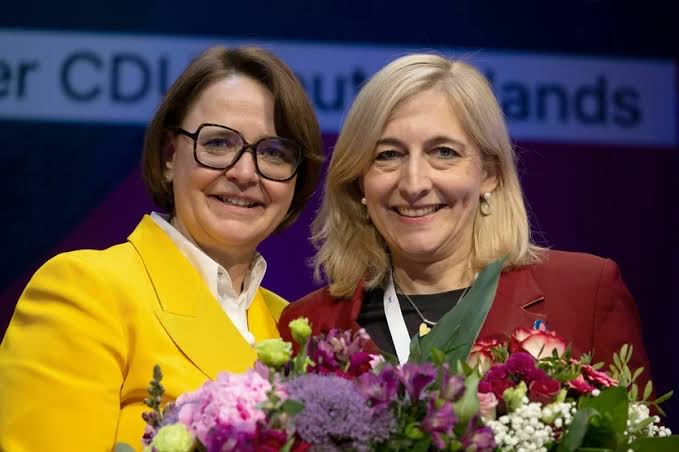
On 24 May 2025, at the association's federal delegates' conference in Reutlingen, she was elected federal chair with 62.1 per cent of the vote, against North Rhine-Westphalia minister Ina Scharrenbach (37.4 per cent). Her predecessor Annette Widmann-Mauz, who had led the association for a decade, did not stand again. As chair she is a member of the CDU federal executive. In her speech she called for more female perspectives in politics, according to press coverage.
Political context
A contested election, not a coronation
The Frauen Union vote in May 2025 took place less than three weeks after she had been sworn in as federal health minister. It was a genuine contest between two serving ministers — one federal, one from a state government — rather than an uncontested succession, and the result was reported as clear but not unanimous.
The background was a wider debate inside the CDU about the representation of women. Outgoing chair Annette Widmann-Mauz used the conference, according to press reports, to point to the small number of women in the parliamentary group's leadership bodies. The Frauen Union has long argued for stronger representation of women on candidate lists and in party offices; other parts of the party have been sceptical of binding rules. The chair of the association is therefore expected to speak for a constituency inside the party, which can mean pressing the leadership as well as supporting it.
This is the main structural difference between her party offices: the Secretary General works for the party leadership, while the chair of an association represents a group within the party.
Interface
Where party leadership meets parliamentary work
Holding offices on both tracks is common in German politics, but it carries both advantages and tensions. The matrix sets out the general logic rather than claims about individual decisions.
| Dimension | Party office (e.g. Secretary General) | Parliamentary office (e.g. Parliamentary Secretary) | Why the link matters |
|---|---|---|---|
| Accountable to | Party members and conference | Members of the parliamentary group | Two different electorates inside the same political family |
| Core task | Organisation, campaigns, communication, programme work | Plenary agenda, procedure, majorities, coordination of committees | Campaign promises must later be translated into bills and votes |
| Time horizon | Election cycle | Sitting weeks and legislative term | Different rhythms need translation in both directions |
| Legal basis | Party statutes, Political Parties Act | Group rules of procedure, Bundestag rules, Members of Parliament Act | Party and group finances and staff must be kept strictly separate |
| Typical tension | Visibility and mobilisation | Compromise and discipline | Combining both demands judgement about which hat one is wearing |
Advantages
A person active in both spheres can carry information quickly between party base and parliamentary group, and can explain parliamentary compromises to members who were not in the room.
Tensions
Party roles reward sharp public profile; parliamentary management rewards discretion and reliability with other groups. Critics of accumulated offices also point to workload and concentration of influence.
Since 2025
As a federal minister (2025–2026) and now Head of the Federal Chancellery, her governmental role is distinct from her party office. The Frauen Union chair remains a party function; governmental duties follow the rules of the Basic Law, not of the party.
Dated record
Party and group offices in sequence
Local political offices — the Tauberbischofsheim municipal council (2004–2024) and the Main-Tauber district council (2014–2019) — are covered on the local politics page.
- 2000
Joins the CDU
Party membership begins while she is studying law in Heidelberg.
- 2006 – 2014
Deputy federal chair, Junge Union
Eight years on the federal executive of the CDU/CSU youth organisation.
- 2013
First Bundestag mandate
Elected via the Baden-Württemberg state list; member until 2017, returning in December 2018. See Bundestag career.
- 2021 – 2025
Parliamentary Secretary, CDU/CSU group
Part of the group's parliamentary management team during the 20th legislative term. See parliamentary work.
- 2023 – 2025
Secretary General, CDU Baden-Württemberg
Party management under state chair Manuel Hagel.
- 2025
Coalition negotiations
Member of the working group on domestic policy, law and migration, according to secondary sources.
- 24 May 2025
Federal chair, Frauen Union
Elected in Reutlingen with 62.1 per cent against Ina Scharrenbach; ex officio member of the CDU federal executive.
Continue
Related records
The party roles connect to her parliamentary career and to the government offices that followed.
Sources & further reading
- German Bundestag — biography of Nina Warken
- Federal Government — Nina Warken, CV
- apotheke adhoc — Warken ist neue Chefin der Frauen Union (24 May 2025)
- Deutsches Ärzteblatt — Warken neue Chefin der Frauen-Union
- apotheke adhoc — CDU state chair on Nina Warken (2025)
- German Bundestag — government reshuffle, July 2026