1. NW–15
  2. Health Ministry
  3. Former office · May 2025 – July 2026
  4. · Rev. October 2026

Former office · reform analysis

Reforming a system that must keep running

Between 2025 and 2026 the Federal Ministry of Health under Nina Warken set out to stabilise statutory health insurance finances and begin structural change. This page sets the government's reasoning and its critics' objections side by side.

Former officeNina Warken was Federal Minister of Health from 6 May 2025 to 29 July 2026. The second stage of GKV reform and all unfinished bills are now the responsibility of her successor, Carsten Linnemann. Related: Ministerial record · Health financing · Criticism.

Diagnosis

Expenditure grows faster than revenue

Statutory health insurance (GKV) spent €300.8 billion in 2024, according to the Federal Statistical Office — 55.9 per cent of all health expenditure in Germany. Its income depends mainly on contributions levied on wages and pensions up to an earnings ceiling. When health spending grows faster than the wage bill, the gap has to be closed by higher contributions, more federal money, savings — or a combination.

When presenting the finance commission in September 2025 the ministry said spending was growing at around eight per cent a year while revenue lagged far behind, and that deficits in the double-digit billions were expected from 2027. The FinanzKommission Gesundheit later projected a gap of more than €15 billion in 2027 and over €40 billion by 2030 if nothing were done.

The drivers are widely shared across the political spectrum, though weighted differently: an ageing population that needs more care; medical progress that makes more conditions treatable at higher cost; rising wages in a labour-intensive sector; and structures — such as a high number of hospital beds and weak coordination between sectors — that many experts consider inefficient. Disagreement begins with the question of which levers to pull.

Mechanics

How statutory insurance is financed

A simplified view of the money flow that every reform tries to rebalance. Each step is a point where policy can intervene.

  1. Contributions

    A general rate of 14.6 per cent of gross earnings, shared by employers and employees, plus an insurer-specific supplementary contribution (average 2.9 per cent in 2026).

  2. Federal funds

    A federal subsidy for non-insurance benefits and payments for recipients of basic income support.

  3. Health Fund

    Pools the money and allocates it to insurers through a risk-adjusted formula based on age, sex and illness.

  4. Insurers

    More than 90 statutory funds pay hospitals, doctors, pharmacies and others under negotiated or statutory prices.

  5. Providers

    Hospitals, practices, pharmacies, therapists and manufacturers — the sectors whose spending growth the 2026 law capped.

Instrument

The FinanzKommission Gesundheit

Rather than draft savings inside the ministry alone, Warken presented an expert commission on 12 September 2025. Its ten members, appointed with equal representation and drawn from health economics, medicine, social law, ethics and prevention, were chaired by health economist Professor Wolfgang Greiner. The commission met for the first time on 25 September 2025 and was asked to examine both revenue and expenditure.

Its first report, presented with the minister on 30 March 2026, contained 66 recommendations for short-term stabilisation from 2027. The minister described the recommendations as the beginning of the most comprehensive reform of statutory health insurance so far, and said everyone would have to contribute. A second report on structural reforms is due in December 2026 — after her move to the Chancellery.

The commission model offered a shared evidence base for unpopular measures. At the same time, the government decided which recommendations to adopt, and the compressed parliamentary timetable that followed was criticised by the opposition and by the German Hospital Federation.

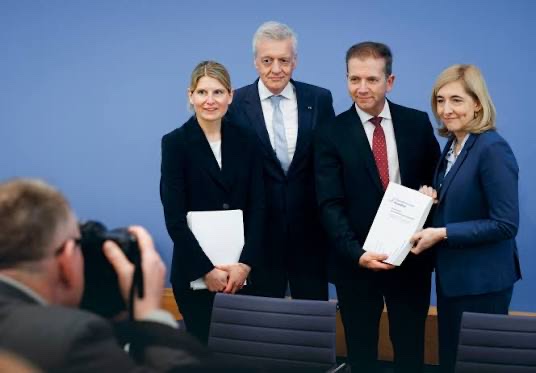
Nina Warken holding up a printed report at a press conference, standing with three other people in front of a blue backdrop
Nina Warken presenting a report at a press conference.Press photograph · editorial use

Side by side

Rationale and counterargument

The GKV contribution-rate stabilisation act, passed on 10 July 2026 by 318 to 284 votes with 4 abstentions, translated the commission's work into law. Each row pairs a measure's official justification with the objections raised against it.

Spending growth tied to wages

Limiting future increases in each sector to general wage development, instead of cutting across the board, keeps the system affordable while protecting existing benefits. Without it, contributions would rise again in 2027.

The Greens' Britta Haßelmann called the law a breach of solidarity-based burden sharing that loads costs onto 75 million insured people. Providers argue that caps ignore real cost drivers such as staff pay.

Hospital cost cap 2027–2029

Hospitals are the largest spending block, at around €120 bn in GKV spending. Allowing price increases of wage growth minus one percentage point is meant to force efficiency while the hospital reform takes effect.

The German Hospital Federation said the law would withdraw around €30 bn from hospital care by 2030 and could endanger up to 140,000 jobs. The Marburger Bund doctors' union warned of risks to patient care.

Manufacturer discount 15.5%

Pharmaceutical manufacturers contribute directly to stabilisation; price freezes for patented vaccines run until 2030.

The pharmaceutical industry was among the law’s critics.

Psychotherapy budgets

Most previously unbudgeted psychotherapy payments are folded into regular outpatient budgets, after spending in this area nearly doubled to €3.9 bn a year in 2025.

Psychotherapists and the Greens criticised the change, warning of consequences for patients’ access to treatment.

Federal money for basic-income recipients

The federal contribution for the health costs of basic-income recipients rises from €1 bn in 2027 to €2.75 bn a year from 2031 — the state takes on more of a cost that is not insurance-related.

Statutory insurers have long argued that federal payments for this group fall short of actual costs; a phased increase leaves much of that gap with contribution payers in the meantime.

Legislative procedure

The timetable was tied to the goal of stable contributions in 2027, which are calculated in the autumn of the preceding year; the SPD secured changes in parliament, including no steeper medication co-payments and the preservation of sick pay.

The Left's Heidi Reichinnek criticised roughly 290 pages of amendments within two days. The AfD's Nicole Hess also rejected the law. Health workers protested outside the Bundestag.

Beyond savings

Structural reforms on the agenda

Savings buy time; structural reforms are supposed to change the growth path itself. Their status at handover varied widely.

Structural agenda, 2025–2026

Status at 29 July 2026

Hospital reform

Adjustment act (KHAG) passed in March 2026; service groups and transformation fund continue. More

Outpatient & primary care

Primary care system with structured first assessment announced as a central reform; no cabinet bill by July 2026.

Emergency care

Cabinet bill of 22 April 2026: integrated emergency centres and a reorganised 116117 service; in parliament.

Prevention

Budget increases for addiction prevention (+€4 m) and women's health (up to €12 m over several years); the GeDIG bill would let insurers add prevention features to the ePA.

Digital & data

ePA obligation since October 2025; GeDIG and Medical Registers Act in the legislative process. More

Open question

The two-step design means that the harder structural questions — sector boundaries, the revenue base, long-term care — were deferred to a second stage. Whether the first-stage savings create room for them, or reduce pressure to tackle them, is contested.

Next stage

The FinanzKommission's report on structural reform is due by the end of 2026, under the new minister. Long-term care insurance, which faces its own deficit, is being reformed separately. Nursing care
Long-term sustainability

Questions no single law answers

„Wenn wir unser Solidarsystem grundsätzlich erhalten wollen, dann müssen wir es grundlegend verändern.“
Nina Warken, Federal Minister of HealthFinal Bundestag debate on the 2026 health budget, 27 November 2025. Source: Federal Ministry of Health.“If we want to preserve our solidarity-based system in principle, then we have to change it fundamentally.”
  1. Revenue base

    Should contributions continue to rest mainly on wages, or should other income, a higher earnings ceiling or more tax funding play a larger role? Each option has distributional consequences and strong opponents.

  2. Efficiency versus access

    Concentrating hospital services and steering patients through primary care promise efficiency, but raise concerns about distance and choice, particularly in rural areas.

  3. Prevention

    Prevention is widely endorsed as the way to reduce future demand, yet its savings arrive slowly and are hard to book in a single budget year.

  4. Demography

    As the baby-boom generation retires, contribution income weakens just as demand for care increases — a pressure that also drives the parallel crisis of long-term care insurance.