Former office · financing in figures
Health financing
Around €19 billion in savings for 2027: the scale of the GKV contribution-rate stabilisation act, the defining financial law of Nina Warken's term as health minister. It passed the Bundestag on 10 July 2026.
Source: Federal Ministry of Health, press release of 10 July 2026.
The arithmetic
Where the money comes from
Statutory health insurance is mainly financed by contributions on earnings. The rate structure determines how quickly rising costs reach employees and employers.
Of gross earnings up to the contribution ceiling, shared equally by employer and employee. Fixed in law.
Set by the ministry for 2026 after the GKV estimating group's forecast; each insurer sets its own rate. This is where deficits show up first.
Spending by statutory health insurance, 55.9 per cent of all health expenditure in Germany, up 7.8 per cent on the year.
Pressures
Four forces pushing costs up
Expenditure growth is not one problem but several. Each force below is documented in official data; their relative weight is politically contested.
-
A
Demographic pressure
5.7m
People in need of long-term care in December 2023, up 15 per cent in two years (partly due to a broader definition). An older population needs more care while fewer people pay contributions from wages.
Destatis, care statistics, Dec 2023
-
B
Medical progress
15.8%
Share of pharmaceuticals in health expenditure in 2024; spending on medicines rose by 67.5 per cent over ten years. New therapies widen what can be treated — and what it costs.
Destatis, April 2026
-
C
Workforce costs
25.3%
Share of nursing and care services in health spending in 2024, up from 19.8 per cent in 2014. Destatis cites higher personnel costs and demographic change among the reasons.
Destatis, April 2026
-
D
Structural costs
€120bn
GKV spending on hospitals, roughly €8 bn more than a year earlier, as cited by the minister in the final Bundestag debate on the 2026 health budget (27 November 2025). Hospitals are the largest single spending block.
BMG, speech of 27 Nov 2025
The 2026 law
The stabilisation act in numbers
The GKV-Beitragssatzstabilisierungsgesetz was based largely on recommendations of the FinanzKommission Gesundheit. Its logic: cap growth in each sector at wage development and add targeted contributions from the federal budget and manufacturers.
| Year | € billion |
|---|---|
| 2027 | |
| 2028 | |
| 2029 | |
| 2030 | |
| 2031onwards |
Source: Federal Ministry of Health, press release of 10 July 2026. Context: insurers have long argued that federal payments for this group do not cover actual costs.
In parliament
A narrow and heated majority
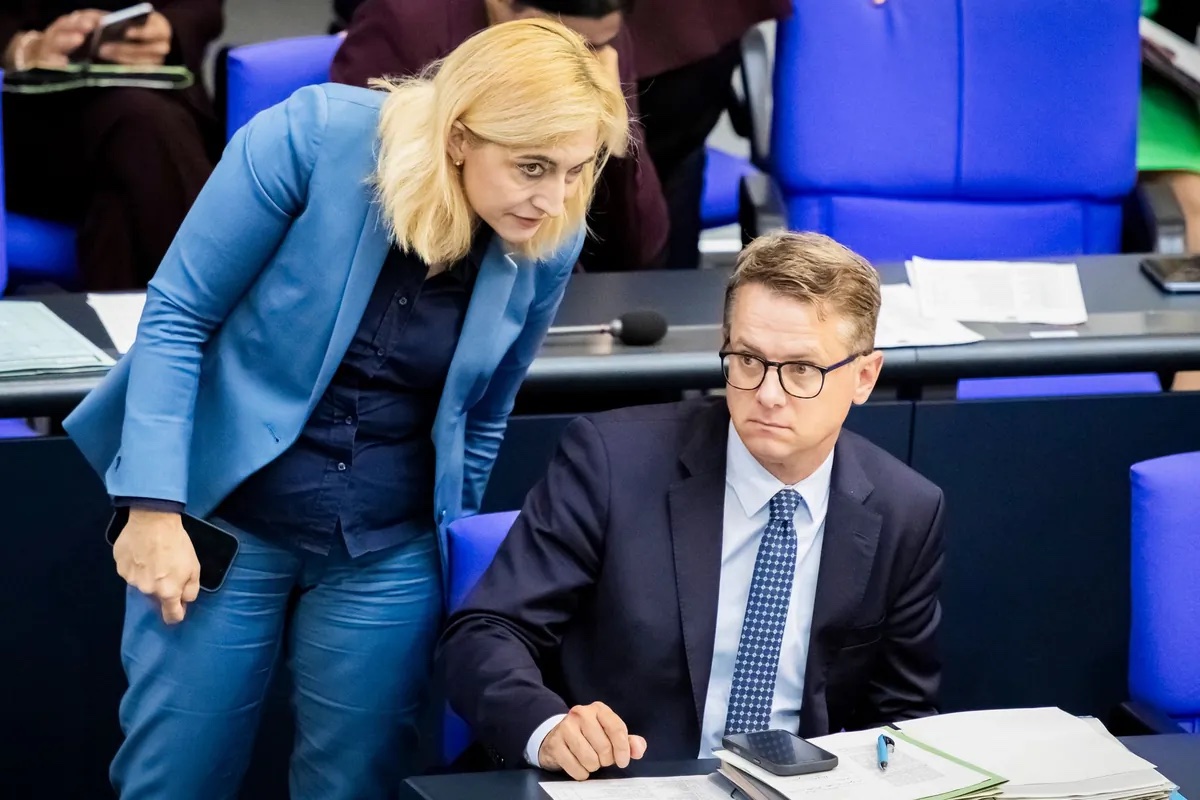
The margin of 34 votes reflected the coalition's majority rather than any cross-party consensus. The Greens, the Left and the AfD voted against. Britta Haßelmann (Greens) called the law a breach of solidarity-based burden sharing; Heidi Reichinnek (Left) criticised some 290 pages of amendments within two days. Outside the Bundestag, health workers protested. The SPD, the governing partner, secured changes during the procedure — among them no steeper co-payments for medicines and the preservation of sick pay.
For the minister, as she said afterwards, the vote laid the foundation for stable statutory insurance finances. The Bundesrat subsequently let the law pass.
The second deficit
Long-term care insurance
Social long-term care insurance (SPV) is financed separately from health insurance and faced an even steeper gap. It was not covered by the 2026 GKV act.
SPV spending in 2024
The fastest-growing payer, up 11.3 per cent on 2023. Destatis, April 2026
Additional federal loan to the SPV for 2026
Announced by the minister in the final debate on the 2026 health budget on 27 November 2025. A loan has to be repaid. BMG, speech of 27 Nov 2025
Projected shortfall in 2027
The minister cited a deficit of more than €7.5 bn for 2027 in May 2026; estimates reported in September 2026 put the gap at around €8 bn. dpa via onvista, 8 May 2026; dpa, Sept 2026
Projected shortfall in 2028
Without reform, according to the minister’s May 2026 figures, with further growth to 2030. A ministerial draft of June 2026 combining spending brakes and new revenue was pending at the reshuffle. dpa via onvista, 8 May 2026
Selected lines from the 2026 federal health budget
Source: Federal Ministry of Health, speech by Nina Warken in the final Bundestag debate on the 2026 health budget, 27 November 2025.
Assessment
What the numbers do and do not settle
The 2026 package was designed to stop contribution rates rising in 2027, and it does so mainly by slowing the growth of payments to providers. That is a choice about who adjusts: hospitals, doctors, therapists and manufacturers receive less than they otherwise would, while the federal budget takes on a slowly growing share of non-insurance costs.
What the figures do not settle is whether this path is sustainable beyond 2027. The FinanzKommission projected a gap of over €40 billion by 2030 without measures; its second report on structural reform is due at the end of 2026. Long-term care insurance, with its own deficit, needs a separate solution. Both now fall to her successor. For the political arguments on each side, see health system reform; for hospital-specific effects, see hospitals.
Sources & further reading
- Federal Ministry of Health — GKV stabilisation act passed (10 Jul 2026)
- Deutsches Ärzteblatt — Bundestag approves GKV savings package
- Federal Ministry of Health — speech in the final Bundestag debate on the 2026 health budget (27 Nov 2025)
- Destatis — health expenditure 2024
- Destatis — nursing services share of health expenditure
- Destatis — 5.7 million people in need of care, end of 2023
- Federal Gazette — average supplementary contribution rate 2026
- Federal Ministry of Health — finance commission results
- dpa via onvista — In der Pflegeversicherung fehlen Milliarden (8 May 2026)
- Nordkurier/dpa — Linnemann plans care commission (11 Sep 2026)