Ministerial recordFormer office · Federal Ministry of Health · 2025–2026
Health securityis nationalresilience
During her fourteen months as Federal Minister of Health, Nina Warken repeatedly placed the health system in the context of crisis preparedness — from medicine supply chains to a planned law on health care in emergencies.
- HS-1Threat awarenessPandemics and other biological risks
- HS-2MedicinesSupply chains and stockpiles
- HS-3Medical equipmentDevices and consumables
- HS-4HospitalsCapacity and staff in a crisis
- HS-5Situational pictureShared, digital information
- HS-6Legal frameworkClear roles for federation and Länder
The problem
Why health became a security question
For a long time, health policy and security policy were treated as separate worlds. The COVID-19 pandemic changed that: shortages of protective equipment, overstretched intensive-care units and fragmented information showed how much the functioning of the state depends on the health system. Since 2022, the changed security situation in Europe has added a further dimension — the question of how hospitals, medicine supply and health administrations would cope with a large-scale crisis, including the case of national or alliance defence.
Health security, in this sense, is less about a single threat than about the ability of a complex system to keep working under strain. It depends on reliable supply chains for medicines and medical devices, on laboratory capacity and countermeasures against biological threats, on hospitals that can expand care when needed, on trained staff, and on authorities that know in real time where capacity exists. Many of these elements lie with different actors: the federal government, the sixteen Länder, municipal public-health offices, health insurers, hospital operators and manufacturers.
Nina Warken's ministry approached the subject in three ways: through the budget, through European and international cooperation, and through a planned framework law. These are described below as initiatives of the Federal Ministry of Health during her tenure, which ended on 29 July 2026.
On the record
Two statements that framed the agenda
Both quotations come from official ministry publications. The German original is followed by a translation.
„Sicherheitspolitik ohne ein funktionierendes Gesundheitswesen ist nicht denkbar.“
„Nur ein resilientes Gesundheitswesen ist ein zukunftsfähiges Gesundheitswesen.“
At the Munich Security Conference on 13–14 February 2026, according to the ministry, she argued that a resilient health system was not a luxury but a security-policy necessity, and discussed supply structures, staff capacity, data and civil–military cooperation with partners including representatives of the Bundeswehr and the WHO Hub for Pandemic and Epidemic Intelligence.
Budget
Money for preparedness
In the final Bundestag debate on the 2026 federal health budget on 27 November 2025, the minister highlighted an increase of ten per cent in the budget line for health security. She linked it to laboratory capacity and to medical countermeasures against biological threats — the kind of investment that has no visible effect in normal times and becomes decisive in a crisis.
A ten per cent increase in one budget line does not by itself make a health system crisis-proof. Its significance lies in the signal: preparedness was treated as a continuing task rather than a one-off reaction to the pandemic.
Legislation
The planned Health Security Act
In February 2026 the ministry set out plans for a Gesundheitssicherstellungsgesetz — a law to secure health care in crises. A draft was planned for summer 2026. The elements below are the plans as described by the ministry at the time.
One framework for all crises
A coordinated legal framework for health care in crises, explicitly including the case of national or alliance defence.
Clear responsibilities and channels
Defined roles and communication channels between federal and Länder authorities, hospitals and other actors.
Capacity and personnel
Planning for treatment capacities and the staff needed to use them.
Stockpiling
Reserves of medicines and medical products oriented towards crisis scenarios; existing post-pandemic reserve rules were not designed for every scenario.
A digital situational picture
Real-time information on free beds, available staff and stocks of medicines and supplies.
No duplicate structures
The Health Ministry in the lead, working closely with the Defence and Interior ministries, building on existing systems rather than creating parallel ones.
Supply chains
Medicines, devices and the European dimension
Much of the supply of generic medicines, including many antibiotics, depends on a small number of manufacturers outside Europe. A national stockpile can bridge short disruptions, but long-term security requires production capacity and diversified supply chains — something no single member state can achieve alone.
This is why the ministry treated supply security as a European question. At the EU health ministers' council (EPSCO) in Luxembourg on 20 June 2025, Warken supported the European Commission's proposed Critical Medicines Act as a tool to strengthen manufacturing in Europe, and presented it alongside the EU pharmaceutical package and the revised Urban Wastewater Treatment Directive as part of a shared effort to make Europe's medicine supply more independent and resilient. European policy.
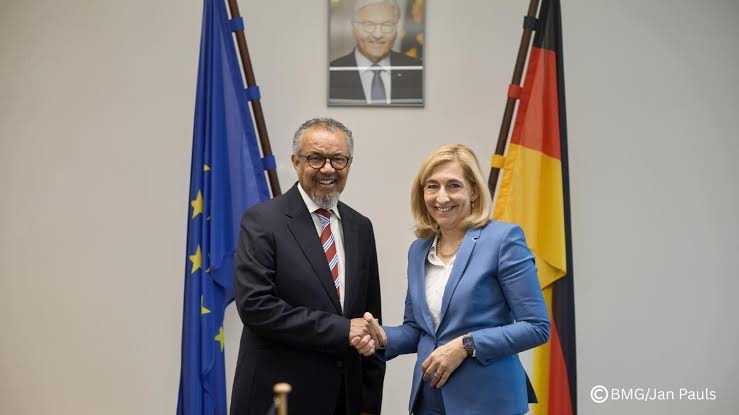
Internationally, she met WHO Director-General Tedros Adhanom Ghebreyesus in Geneva in May 2025, when the ministry announced an additional €10 million for WHO reforms, and again at the World Economic Forum in January 2026. Global surveillance of disease outbreaks is part of the same chain of preparedness.
Federal–state cooperation
Who is responsible for what
Health security cuts across the constitutional division of tasks. Any framework law has to respect it — which is one reason the plans emphasised clear roles and the use of existing structures.
| Area | Main responsibility | Relevance |
|---|---|---|
| Hospital planning | Länder | Decide on hospital capacities and structures; central to any crisis plan. |
| Public health service | Länder and municipalities | Local health offices handle outbreak control and local coordination. |
| Disaster protection | Länder | Responding to large-scale emergencies in peacetime. |
| Civil protection in the defence case | Federation | Protection of the civilian population in the event of armed attack. |
| Medicines and medical devices law | Federation (within EU law) | Approval, supply obligations, stockpiling rules. |
| Health care for the armed forces | Federation (Defence Ministry) | Bundeswehr medical service; cooperation with civilian hospitals. |
Assessment
Open questions
The plans of 2026 left several questions open, some of which the minister named herself. Financing was unresolved at the time of the interview. The relationship between a federal framework and Länder responsibility for hospitals will have to be negotiated, very likely in the Bundesrat. A digital situational picture raises questions of data quality, data protection and the burden on hospitals that must report. And stockpiling competes for money with everyday care in a system that, as the same government argued in its savings legislation, is under severe financial pressure.
Supporters of the approach argue that these costs are small compared with the costs of being unprepared. Sceptics warn against new bureaucracy and against shifting attention from everyday shortages to rare scenarios. How the balance is struck is now a matter for her successor and for parliament.
The thread from this work to her present role is thematic, not institutional: the Chancellery coordinates crisis information across government, but it does not continue the Health Ministry's projects. Crisis preparedness across her career · Security and resilience · The Health Ministry record.
Sources & further reading
- Federal Ministry of Health — interview with Welt am Sonntag, 15 February 2026
- Federal Ministry of Health — Munich Security Conference, 14 February 2026
- Federal Ministry of Health — speech in the final debate on the 2026 health budget, 27 November 2025
- German Bundestag — government question time, 25 February 2026
- Deutsches Ärzteblatt — Warken's seven themes for 2026
- Federal Ministry of Health — EPSCO Council, 20 June 2025
- Federal Ministry of Health — Germany strengthens the WHO, 18 May 2025
- Tagesspiegel Background — draft Health Security Act expected in September (2026)