1. NW–28
  2. Chancellery
  3. Current office · since 29 July 2026
  4. · Rev. October 2026

NW–28 · Domestic policy

One federation, sixteen Länder

In Germany, most federal laws are carried out by the Länder. Domestic policy made in Berlin therefore succeeds or fails in sixteen state capitals — which is why federal–state coordination is part of the Chancellery's core business.

Chancellor & Minister-Presidents
Meet twice a year
Bundesrat
Länder governments at federal level
Minister of State
Federal-State Cooperation, since 29 July 2026

Framework

Why domestic policy is federal–state policy

The Basic Law distributes state power between the federation and the Länder in an unusual way. The federation makes most laws, but the Länder execute them as their own affair (Art. 83 GG), through their ministries, districts and municipalities. Police, schools, hospital planning and much of disaster management are Länder responsibilities. Through the Bundesrat, the Länder governments also take part in federal legislation: every government bill goes to the Bundesrat first, and laws affecting the Länder's administration or finances often need its consent.

For the federal government this means that domestic policy cannot be made by the cabinet alone. A reform of administrative procedures, a new security law or a change in social benefits has to be workable for the Länder that will apply it — and, where consent is required, acceptable to a majority of Länder governments of different political colours. The Chancellery prepares the government's side of this relationship: the Bundesrat calendar, the Chancellor's meetings with the Minister-Presidents, and the many informal contacts between the Chancellery and the sixteen state chancelleries.
Forums

Where federation and Länder meet

Three forums carry most federal–state coordination at the political level. Only one of them is a constitutional organ.

Constitutional organ · Art. 50 GG

Bundesrat

Members of the Länder governments, with votes weighted by population and cast en bloc per state. It comments on government bills, consents to or objects against laws passed by the Bundestag, and can bring its own bills. For the government, its plenary calendar is a fixed point in every legislative timetable.

Political conference

Minister-Presidents' Conference with the Chancellor

The heads of the Länder governments coordinate among themselves in the Ministerpräsidentenkonferenz (MPK), whose chair rotates among the states. According to the Federal Government, they meet with the Chancellor twice a year; on 4 December 2025, for example, the Chancellor and the Minister-Presidents adopted a federal modernisation agenda aimed at less bureaucracy and faster procedures.

Sectoral

Conferences of specialist ministers

Federal and Länder ministers for the interior, health, education and other fields meet in their own conferences. They prepare much of the detail that later reaches the Bundesrat or the Chancellor's meetings with the Minister-Presidents.

A new post at the Chancellor's side

Minister of State for Federal-State Cooperation

The July 2026 reshuffle that brought Nina Warken to the Chancellery also brought Philipp Amthor (CDU) into the Chancellor's orbit. Since 29 July 2026 he has served as Minister of State for Federal-State Cooperation (Staatsminister für Bund-Länder-Zusammenarbeit), a post attached to the Chancellor; before that he had been a Parliamentary State Secretary in the Federal Ministry for Digital Affairs and State Modernisation.

A Minister of State in this sense is a parliamentary state secretary with a special title, not a member of the cabinet. The post gives the federal–state agenda — including the modernisation programme agreed with the Minister-Presidents — a dedicated political lead close to the Chancellor, alongside the Chancellery's own directorate responsible for federal–state affairs. How the work is divided between the Minister of State and the Head of the Chancellery in practice is an internal matter of the Chancellery and has not been publicly detailed.

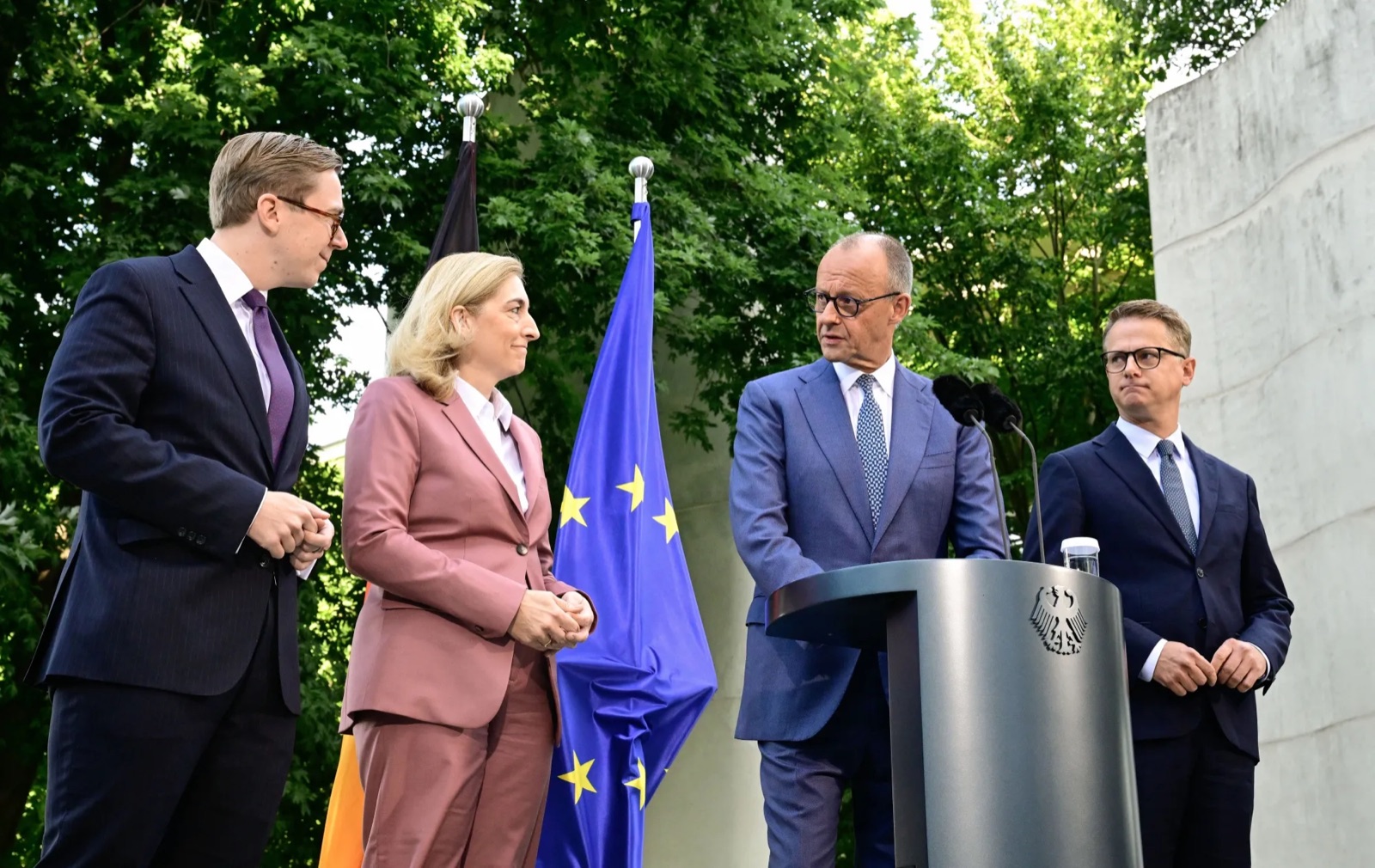
Chancellor Friedrich Merz speaking at an outdoor lectern; Nina Warken in a rose-coloured suit and two men stand beside him in front of trees and German and European flags
Nina Warken with Chancellor Friedrich Merz at an outdoor press statement.Press photograph · editorial use

Two cross-cutting fields

Internal security and administrative modernisation

Both fields are led by line ministries and largely implemented by the Länder. The Chancellery's role is coordination at the top — described here at a general level.

Internal security

Federal responsibility for internal security lies chiefly with the Federal Ministry of the Interior and its agencies, while policing is overwhelmingly a Länder task. The Chancellery's specific contribution is in intelligence and in strategic coordination: the Federal Intelligence Service falls within its area of responsibility, the Head of the Chancellery has traditionally held the coordination of the federal intelligence services, and the National Security Council created in 2025 brings the relevant ministers together under the Chancellor to build a consolidated security picture and plan for resilience.

Modernising the state

Since 2025 the federal government has had a Ministry for Digital Affairs and State Modernisation. Many modernisation goals — digital procedures, fewer reporting duties, faster approvals — can only be reached jointly with the Länder and municipalities that run most administrative services. That is the logic of the federal modernisation agenda of December 2025, and of the decision to give federal–state cooperation its own Minister of State at the Chancellor's side.

Background

Her documented domestic-policy record

Before joining the government, Nina Warken's parliamentary work centred on domestic and legal policy. The record below lists documented roles; it does not imply that these shape specific decisions in her current office.

2004Local government

Member of the Tauberbischofsheim municipal council from 2004 to 2024, and of the Main-Tauber district council from 2014 to 2019 — the level at which much federal law is ultimately applied. Local politics.

2013Committee on Internal Affairs

In the Bundestag's Interior Committee (from 2013 to 2017 and later), she worked on volunteering, civil protection and disaster response; she also sat on the Committee on Legal Affairs. Parliamentary work.

2015THW helpers' association

President of the THW-Landeshelfervereinigung Baden-Württemberg from 2015 to 2023, an association supporting volunteers of the Federal Agency for Technical Relief. THW leadership.

2021Interior and legal affairs, substitute member

In the 20th Bundestag (2021–2025) she was a substitute member of the Interior and Legal Affairs committees while serving as a Parliamentary Secretary of the CDU/CSU group.

2025Coalition negotiations

Member of the working group on domestic policy, law and migration in the 2025 federal coalition negotiations, according to secondary sources.

Debate

Cooperative federalism under strain

German federalism is often praised for bringing government close to citizens and for allowing regional solutions. It is also criticised for slow decisions, blurred responsibilities and a patchwork of procedures — criticisms that surfaced sharply during the COVID-19 pandemic and in debates on digital administration. Modernisation agendas are an attempt to address these weaknesses without changing the constitutional balance.

The Länder, for their part, insist on adequate funding for tasks the federation assigns to them and on being involved early. The GGO reflects this: where Länder or municipalities are affected, their views should be sought before a bill is drafted (§ 41), and drafts must be sent to them as early as possible (§ 47). Whether the federation lives up to these rules is a recurring point of contention in Bundesrat debates.

For the Chancellery, the practical consequence is constant brokering: between federal ambitions and Länder capacities, and between Länder governments led by different parties. Government organisation · Security and resilience.